顯示具有 練英文 標籤的文章。 顯示所有文章

2010年10月27日 星期三

[讀書會]

Thursday, Oct. 21, 2010

City Centered

By Bruce Katz

With our recovery sluggish and our politics in rancorous free fall, the U.S. is on a desperate search to create jobs in the near term and retool the economy for the long haul. As Dorothy found in The Wizard of Oz, the answers surprisingly lie no farther away than home, or more precisely, the top 100 cities and their environs — the major metros — where most Americans live, work and play.

(原文連結)

City Centered Outline

n The U.S. is on a desperate search to create jobs in the near term and retool the economy for the long haul.

The solution lies in the top 100 cities and their environs — the major metros — where most Americans live, work and play.

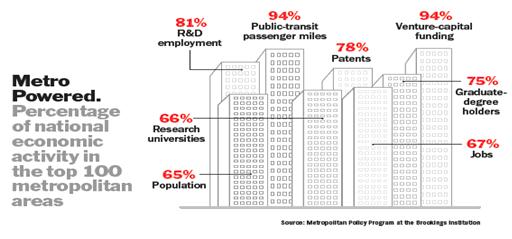
n Metro Powered — features of Metro in United State

House almost two-thirds of our population

Generate 74% of our gross domestic product (GDP)

Disproportionately concentrate the assets that drive economic success:
(1) patents, (2) advanced research and (3) venture capital, (4) college graduates and Ph.D.s, and (5) air, rail and sea hubs.
n This dynamic holds not only for the U.S. but also around the globe.

The rise of Brazil, India and China is a direct product of their rapid urbanization and the growth of supersize metro economies like São Paulo, Mumbai and Shanghai.

n We mythologize the benefits of small-town America, but it's the major metros that make the country thrive.

Placing too much tax revenues on suburb. Prosperous small towns are most often suburbs of major cities.

Pursuing urban policies devoted to subsidized housing and tax incentives to revitalize inner-city neighborhoods rather than creating policies that, for example, support powerful and promising industry clusters.

"Cities are places where two plus two equals five."
Ideas collide and flourish. New inventions and processes emerge in research labs and on factory floors. New products and companies follow.

n Worldwide competitors understand that prosperity in this century will come via the distinct assets and attributes of their metro engines.

Germany, China and Brazil are investing in wholesale change through advanced research, renewable energy, modern ports, high-speed rail and urban transit in Munich, Shanghai and São Paulo — the metros that drive their economies.

n What American should do?

Revenue
Reducing the federal deficit, and the other half, to efforts grow export.

Infrastructure
Start investing to help American businesses innovate and have access to a world-class infrastructure.

Meet the Challenges
Cities and suburbs need to team up with businesses to devise export initiatives that build on their metro's distinctive position in the market.

Question:

1. What do you think about the global competition in the Metros?

2. Does it against the American Dream, if the government redirects their resource away from suburb resident?

2010年10月20日 星期三

[讀書會] Currency War

The global economy

How to stop a currency war

Keep calm, don’t expect quick fixes and above all don’t unleash a trade fight with China

Oct 14th 2010


IN RECENT weeks the world economy has been on a war footing, at least rhetorically. Ever since Brazil’s finance minister, Guido Mantega, declared on September 27th that an “international currency war” had broken out, the global economic debate has been recast in battlefield terms, not just by excitable headline-writers, but by officials themselves. Gone is the fuzzy rhetoric about co-operation to boost global growth. A more combative tone has taken hold (see article). Countries blame each other for distorting global demand, with weapons that range from quantitative easing (printing money to buy bonds) to currency intervention and capital controls.

(原文連結)

Currency War

Brazil’s finance minister declared the “International currency war” had broken out.

n Counties blame each other for distorting global demand, with weapons including quantitative easing (printing money to buy bonds), currency intervention, and capital control.

n Three battles

ü China’s unwillingness to allow Yuan to rise more quickly

ü Rich world’s monetary policy : quantitative easing

ü Developing countries’ response to the capital flows

n Still modest now, but it may turn into real trade war

ü Sluggish economy growth in the rich world is likely to last for years.

ü As fiscal austerity kicks in, the appeal of using a cheaper currency as a source of demand will increase.

n Developing countries’ counter measure to capital flood

n If the flood of foreign capital intensifies, developing countries may be forced to choose between:

ü Losing competitiveness hurt export

ü Draconian capital controls decrease FDI & economy recovery

ü Allowing their economies to overheat inflation

n The rich world’s mix of fiscal austerity and loose monetary policy—will have an uncomfortable impact on small, open emerging economies, in the form of unwelcome capital inflows. Taiwan


Question:

Do you agree or disagree that the government should intervene in the market in order to maintain their export competitive?

2010年10月5日 星期二

[讀書會]How Should America Handle Extreme Speech?

How Should America Handle Extreme Speech?

By NANCY GIBBS Sunday, Oct. 03, 2010

Illustration of the Statue of Liberty holding a burning book.

In the end, Pastor Terry Jones did not burn a Koran, and another eternally sad and suddenly bitter 9/11 anniversary came and went. But he'll be back — if not Jones, then the swarms of zealots and charlatans who were inspired by how a preacher with a congregation of about 50 could command the attention of the White House, the Pentagon, the Vatican, Sarah Palin, Angelina Jolie and just about every network, newspaper and blog in the land. It was called a media circus, but it was the kind in which the clowns attacked the children and everyone walking the tightrope looked down and couldn't see any net.

(原文連結)

Freedom of speech & Extreme Speech

n Background

ü The Jones did not burn a Koran on 9/11 anniversary, but he'll be back.

ü Those inspired by how a preacher could command the attention of the White House, the Pentagon, the Vatican, Sarah Palin, Angelina Jolie and just about every network, newspaper and blog in the land.

n Contrivers event in freedom of speech

The right of Nazis to march

Journalists to publish government secrets EX. Wiki Leak

Racists to burn crosses

n Free-speech protections in the U.S. are stronger than in any other place on earth at perhaps any time in history

First Amendment to the United States Constitution

Congress shall make no law respecting an establishment of religion, or prohibiting the free exercise thereof; or abridging the freedom of speech, or of the press; or the right of the people peaceably to assemble, and to petition the Government for a redress of grievances.


美國憲法第一修正案對美國影響巨大。美國媒體所享有的一切自由都源於此,在美國,凡是涉及言論、新聞、出版等訴訟,往往都會搬出此,它幾乎成為美國媒體或個人言論自由的護身符,不可動搖。以至於美國人把它頌揚為「美國生活方式」的主要內容。-- 維基百科wiki

n The Effect of Technology

ü As technology evolves, individual rights have global repercussions. Speech toward domestic audience will cause international intention. EX: Is Jones trying to incite violence or express his “expectation”Where’s the line?

ü Facebook & Tweet
Today, a crusader on a mission doesn't need a lot of P.R. budget, if you know how the media ecosystem works.

n Solution: freedom of speech vs. freedom of the press

ü The right to speak does not include a right to be heard: editors often choose not to cover idiotic or offensive behavior.

2010年9月28日 星期二

[讀書會]Tea Party Movement

The New York Times 原文連結

Outline

A diffuse American grass-roots group taps into antigovernment sentiments.

Origin:

n Protest of the economic stimulus package.

n Block the Democratic agenda on the economy, the environment and health care.


Tea Party supporters tend to unite around fiscal conservatism and a belief that the federal government has overstepped its constitutional powers.

n Generally, they are more conservative and have stronger attitude than Republicans toward Washington.

n Tea Party supports think they create a gross-rooted moment, but others consider there are financial and political supports from current or former Republican leaders behind them.

Achievements:

n They play a significant role in several important primary elections, mainstream candidates backed by tea party figures who won the Republican nomination including Christine O’Donnell of Delaware.


Why they hate Obama?

n They believed the direction of the country and the conviction that the policies of the Obama administration are disproportionately directed at helping the poor rather than the middle class or the rich.

n The poor vs. the rich à individualism à Anti-socialism
Blacks vs. Whites equality
They are more likely than the general public, and Republicans, to say that too much has been made of the problems facing black people.


Political Impact

n Tea Party fervor was expected to help Republicans, but also create the opportunities for the Democrats. (泛藍/國親分裂)

n It took Republican too much energy and money on primary election, which should be an easy task at the beginning. Also, historically the House race prefer moderates. The tea party has gone beyond.


Future Challenges

n Tea Party victories have come as the result of voter protests. In the general election, voters will focus on what the Tea Party is for, rather than what it is against.

n Whether voters will decide to embrace the idea that slashing spending deeply enough to balance the budget while cutting taxes and relying more on charity to provide the social services.


2009年12月30日 星期三

[讀書會] 伊拉克二三事

Don’t Forget America’s Other War


Published Dec 19, 2009

From the NEWSWEEK magazine issue dated Jan 4, 2010


Remember Iraq? For months our attention has been focused on Afghanistan, and you can be sure that the surge will be covered exhaustively as it unfolds in 2010. But the coming year could be even more pivotal in Iraq. The country will hold elections in March to determine its political future. Months of parliamentary horse trading will likely ensue, which could provoke a return to violence. The United States still has 120,000 troops stationed in Iraq, and all combat forces are scheduled to leave by August, further testing the country's ability to handle its own security. How we draw down in Iraq is just as critical as how we ramp up in Afghanistan: If handled badly, this withdrawal could be a disaster. Handled well, it could leave behind a significant success.


(全文連結)


OUTLINE:


2010 could be a crucial year for Iraq

  • The country will hold elections in March to determine its political future.
    Giving Iraq’s leaders a chance to resolve their political differences.

  • All 120,000 American troops are scheduled to leave by August.
    Testing the country’s ability to handle its own security.

Political differences in Iraq

  • Sunnis vs. Shias (They are fueling the civil war in the first place)
  1. SunnisA majority that has traditionally been the country’s elites.
  2. ShiasA relative minority that remains marginalized politically in Iraq.

  • Kurds (They run an autonomous quasi state at north provinces.)
  1. They ignore Iraq central government’s authority regarding oil contracts by negotiating on their own and, in the same time, block the flow of oil out of Kurdish region.
  2. Disputes of drawing boundaries make situation more complex.

Challenge and Chance

  • Iraq needs a stable power-sharing deal to keep all three groups invest in their new state.
  • The U.S. should use their enormous political influences and leverage to help Iraq’s three parts reaching a compromise.
  • Iraq could still become a remarkable model for Arab world.


Question:

  1. What do you know about Iraq?
  2. Should the America need to invade Iraq at the very beginning?Do we have the alternatives?

2009年12月1日 星期二

How to feed the world


Agriculture,原由 thegreenpages 上載。

Robert Malthus once said that “[t]he power of population is indefinitely greater than the power in the earth to produce subsistence for man. Population, when unchecked, increases in a geometrical ratio. Subsistence increases only in an arithmetical ratio.” If this were true, the production of food will never be able to keep up with the growth of population.


However, thanks to the Green Revolution in agriculture, Malthus’s prediction did not come true. Technological improvement in crop planting has helped us produce food in a more efficient way. We can lower inputs into the production process, but at the same time double or triple production. New technologies have brought food production to record levels. In theory, the food we produce could feed everyone on earth. But for many complex reasons we face a bizarre situation: we live in a world both with hunger and obesity. According to FAO (Food and Agriculture Organization of United Nation) data, 1.02 billion people are undernourished worldwide in 2009, which means that out of every six people, one person is going hungry. Ironically, while some are starving to death, there are more than one billion people who are overweight. This is almost equal to the number of people who are facing hunger.


We have regarded the worldwide hunger as a problem of uneven distribution for a long time, because we do believe there is enough of food for everyone. Nevertheless, the food crisis during 2007-2008, right before the financial crisis broke out, revealed a new aspect to the problem. Because the oil price rose, food and commodities prices also rose. Suddenly, we did not have enough food. Making the situation worse, many crops were being used for biofuel rather than to feed people. The food problem today is not only the result of uneven distribution, but also the limited capacity of agriculture and the failure of the food market.


The outbreak of the financial crisis has driven people’s attention away. But even with economic recovery, the food crisis remains unresolved. By 2050 the world’s population will rise by a third, from 6.7 billion to almost 9 billion. The demand for agriculture goods will rise 70% and demand for meat will double. We will not be able to meet these increases without farmers clearing large amount of new land or using up lots more water. However, farmland is often transferred to more lucrative uses, while clean water supplies are so limited in some parts of the world that there is not even enough to drink. Moreover, farmers still have to fight global climate change and its attendant unpredictable rainfall and devastating natural disasters.


The Economist suggests we need to do two things to prevent the impending crisis. First of all, invest in the productive capacity of agriculture. Money invested in agriculture has declined since the Green Revolution took place. More investment will lead to more production. Investment in agriculture can be used to provide farmers with better seed and fertilizers or to develop genetically modified crops. Shocked into action by soaring food prices, governments and international organizations working in affected areas have doubled the amounts invested in food production.


Secondly, we need to improve the operation of the food market. Governments tend to favor self-reliance on food for security reasons. In other words, countries produce their own food even without a comparative advantage, so their agriculture relies on subsides from the government. This leads to market failure as protectionism blocks the free trade and free market.


To feed 9 billion people, farming needs to be as efficient a possible. That requires markets and trade, but also more investment.


2009年11月25日 星期三

[讀書會] 糧食問題

How to feed the world

Nov 19th 2009
From The Economist print edition
Business as usual will not do it

IN 1974 Henry Kissinger, then America’s secretary of state, told the first world food conference in Rome that no child would go to bed hungry within ten years. Just over 35 years later, in the week of another United Nations food summit in Rome, 1 billion people will go to bed hungry.
(全文在此)

OUTLINE:

Robert Malthus 馬爾薩斯:

“The power of population is indefinitely greater than the power in the earth to produce subsistence for man. Population, when unchecked, increases in a geometrical ratio (等比成長). Subsistence increases only in an arithmetical ratio (等差成長). “


“Green revolution” of agriculture 綠色革命

The technology improvement of crop planting helps us producing food in an efficient way.

In theory, the food we produced can feed everyone on earth. However, so many complex reasons that contribute to a bizarre situation: we live in a world with hunger and overweight.


人類今日的糧食生總量,超越了歷史上的任一時刻。然而在此同時,地球上處於飢餓狀態的人口卻超過十分之一。諷刺的是,伴隨著這八億飢餓人口的是另一個歷史記錄,那就是超重人口的數目達到十億人,遠大於飢餓中的人數。


Food crisis 糧食危機 & Financial crisis 金融危機

Food crisis was masked by the financial crisis.

Before the crisis broke out the oil price, the food price and all commodities prices were soaring.

· Not uneven distribution, but the capacity of agriculture and structure of food market.

· By 2050 the world’s population will rise by a third, from 6.7 billion to almost 9 billion

· New land, more water, climate change


Food prices keep rising; the Economist suggests we need to do two things:

1. Invest in the productive capacity of agriculture.

· An industrial thinking: more investment, more production

· Not organic, sustainable, but GM food, chemical fertilizers, and industrial agriculture

· No matter how, shocking by the soaring price, government have doubled the money


2. Improve the operation of food market.

· Farmer’s access to market: a reliable market is the incentive to grow more.

· Government tend to be self-reliance on food, food security -> distrust of market and trade -> subsidies ->block the free trade and free market -> protectionism

Question:

  1. Some people argue that the pursuing of organic food is impossible to feed the world, what do you think about that?
  2. Is it necessary for a country to become food self-sufficiency? Why or why not?

2009年11月16日 星期一

柏林圍牆倒塌 Capitalism and Democracy


Twenty years have gone by since the collapse of Berlin Wall in 1989. It was a remarkably historical event from every aspect. Not only because it brought to an end of years of conflict between East and West, but also it announced the victory of capitalism and democracy in an ideological war with communism. However, capitalist democracy did not win completely. Many countries around the world today are adopting a modified capitalism rather a pure one. And democracy has bumped into a number of difficulties along the way.

From the viewpoint of the West, capitalism will bring in democracy eventually, because the emerging middle class in a capitalist society will surely have an appetite for liberty beyond the purely economic. When the Soviet Union was broke up, it seemed to prove the inefficiency of communism. Former communism countries in central and east Europe have made themselves embrace the capitalism and free market, the governing principals of commerce. And they spread out through globalization. The free movements of goods, capitals, personnel, and ideas around the world have boosted the prosperous economy, so few places openly oppose it.

However, there is still a huge gap between the economic freedom in capitalism and the political freedom in democracy. For some countries like China or other members of WTO maintain an authoritarian regime while participating in global economy. With the support of their authoritarian government, large multinational corporations are attracted to invest in the local market, which promotes economic development and, at the same time, stabilizes the legacy of their rule. Therefore, the process has led to a gradual move toward capitalism but away from democracy.

On the other hand, with the free trade and globalization, China and other emerging giants are catching up with developed countries, which creates fear in the West about losing relative economic power and leads to calls for protectionism among public. In a democratic society, if these concerns continue to grow the public will vote a relatively conservative government and reverse the process of free trade and free market, the important elements of capitalism.

In short, the hypothesis of a relationship between capitalism and democracy is never definite and we should not take it for granted.

2009年10月19日 星期一

IMF的投票權之爭

The reorganization of financial order worldwide

Two days of annual meetings at the World Bank and the International Monetary Fund (IMF) ended last week (October 7th) in Istanbul. The main focuses this time were to inject more funds into the World Bank and shift the specific ratio of voting rights from developed countries to developing ones inside the IMF. However, they did not reach a consensus on a number of issues which implied a shift of power within the organization.

The World Bank is not a bank in common sense. It is actually made up of two international development institutions, the IBRD (International Bank for Reconstruction and Development) and the IDA (International Development Association), which provide low-interest loans and grants to developing countries. The IMF is working to foster global monetary cooperation and international trade, while at the same time securing financial and monetary stability. Both of them were one of the three pillars of Bretton Woods system, and still survive today in the post-Bretton Woods era.

Even though the developed countries agree that the economy has not fully recovered yet and it is too early for governments to drop their stimulus programs now, they still have different opinions on boosting funding for the World Bank, not to mention demands by big developing countries for more voting power.

The shift in power can also be seen in the fact that the G20 summit is gradually replacing the G7’s function as the primary forum for international economic cooperation. The former includes big rich countries and emerging ones, but the later consist of rich countries only. As a matter of fact, the discussion of redistribution in voting power in the IMF followed conclusions made by the G20’s summit last month.

Such a power shift in international organization implies the influence of rich countries is not as strong as before and the emerging countries want a bigger say.

According to statistical data, the voting power in the IMF has trouble representing the real contributions of each country to global economic growth. Some rich countries are over-represented and some emerging countries like China and India are under-represented. In 2008, China accounted for 11.3% of global GDP growth but only got 3.1% of voting power in the IMF, and India contributed 4.9% to global GDP but only had 1.9% of the voting power in the IMF. They have therefore demanded that the European countries hand at least 5% of the voting power to them. Europeans appear supportive of this demand in principle, but in reality their position is very different.

Vested interests

As most international organizations were designed by the leading power at the time, institutional design is normally in line with the interests of this power. Therefore, the vested interests do not want to let go of the power in their hand when a new power is rising. So, how former leading powers accommodate themselves to the rise of these emerging countries may be the primary challenge facing these international organizations.

接連兩天在伊斯坦堡舉辦的世界銀行與國際貨幣組織年會於上週結束,討論的焦點則圍繞在是否挹注更多的資金給予世界銀行,以及如何從已開發國家轉移部分國際貨幣組織的投票權給予發展中國家。但關於這點,會議中並沒有產生太多共識,因為IMF內部任何的改變都將會造成權力的重組。


世界銀行並不是我們一般認為的銀行,它事實上是由兩個國際發展機構IBRD(國際復興開發銀行)與IDA(國際開發協會)所組成,他們主要的功能在於提供發展中國家低利率的貸款以及資金援助。而國際貨幣組織則負責促進全球貨幣與貿易合作,同時確保全球金融與貨幣的穩定。他們兩者都是形塑今日全球金融秩序的布列敦森林體系三大支柱之一。

儘管大家都同意全球經濟尚未完全復甦,且現在對於各國政府結束各項刺激景氣的方案還言之過早。但是在是否挹注更多資金給世界銀行,大家的意見分歧,更不用說在討論崛起中國家要求更多投票權這件事情上。

這股權力移轉的趨勢,我們也可以從G20峰會漸漸取代G7峰會,成為全球最主要的經貿合作論壇這件事上看出一點端倪。前者是由有錢的大國與崛起中的發展中國家共同組成,而後者則是有錢國家才可加入的有錢人俱樂部。事實上,本次大會討論的投票權移轉問題,就是依循上個月底結束的G20峰會產生的共識而來。

國際組織中的權力開始移轉,也暗示有錢國家的影響力已經不像以前那麼強大,同時開始崛起的發展中國家則希望在國際上擁有更多發言權。

根據統計資料,現階段IMF的投票權分配已經無法反映全球經濟成長的現況。某些有錢國家獲得了高於本身貢獻的代表性,而部分發展中國家則嚴重被低估,比方說中國與印度。2008年的全球生產毛額,中國佔了全球的11.3%,卻只在IMF獲得3.1%的投票權。而印度貢獻了全球GDP的4.9%,但他在IMF的投票權只有1.9%。他們將矛頭指向歐洲國家,希望他們能夠交出至少5%的投票權,轉移給他們。

既得利益者

由強國所主導的國際組織,其運作通常也需合乎他們自身的利益,也唯有如此才能成功推動該組織的運作。 所以,當新興發展中國家的力量開始崛起時,這些既得利益者也不願意放棄手中握有的特權。

以聯合國為例,安理會的絕對否決權的大國一致原則,與聯合國大會票票等值的民主運作原則顯然產生許多衝突。當初這種雙軌設計,是為了確保大國加入的意願而使組織具有實質影響力,同時有廣泛會員凸顯其代表性。如今舊時代的秩序開始受到新秩序的挑戰,過去幾年關於聯合國改革的議題也時常成為國際焦點。回到IMF本身,隨著全球經濟實力的消長,開發中國家應該獲得更多代表權,並共同決定世界發展的方向,而非仍舊全由開發中國家所主導。

因此,如何調和這些崛起中國家的需求與強權的利益,將會是這些國際組織要面對的主要挑戰。